Uncovering Latency Reduction Mechanisms Through Predictive Caching in Global Content Distribution Networks for Video Platforms
Rafael Brooks · Oct 14, 2026

Uncovering Latency Reduction Mechanisms Through Predictive Caching in Global Content Distribution Networks for Video Platforms
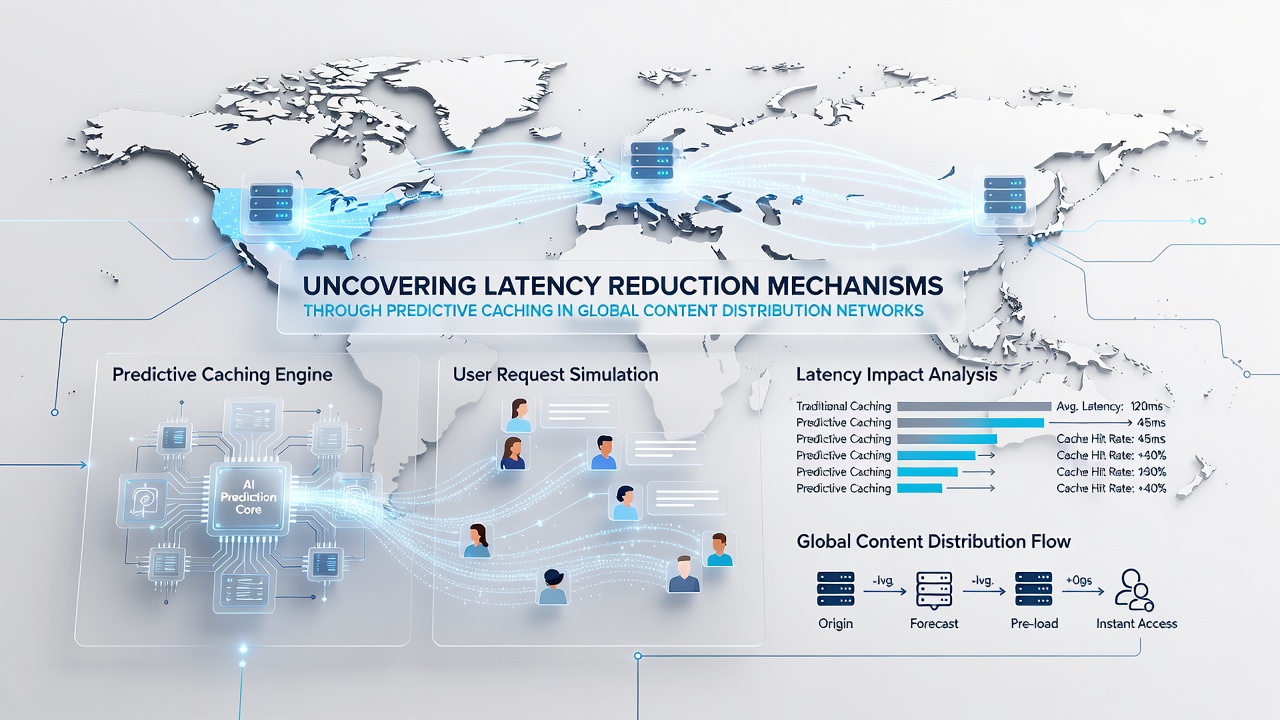
Video platforms rely on global content distribution networks to deliver streams with minimal delay, and predictive caching stands out as one mechanism that anticipates viewer requests before they occur. Data from network operators shows that these systems analyze user behavior patterns across regions, prefetch segments of video content to edge locations, and thereby cut retrieval times during peak viewing hours. Researchers at institutions tracking traffic in October 2026 noted consistent reductions in round-trip times when algorithms incorporated historical viewing data alongside real-time signals such as device type and connection quality.
Core Components of Predictive Caching Systems
Engineers design predictive models that combine machine learning classifiers with time-series forecasting to determine which video chunks will likely be requested next, and these models run on distributed nodes rather than centralized servers. The process begins when an edge cache receives metadata about ongoing sessions, processes it through trained neural networks, and then pulls anticipated files from origin servers during off-peak windows. Observers note that this approach differs from reactive caching because it shifts bandwidth usage earlier, smoothing out spikes that would otherwise strain backbone links.
Key variables fed into the models include geographic clustering of viewers, genre popularity trends, and session duration statistics, while additional inputs such as social media mentions or scheduled live events further refine accuracy. According to a report published by the European Telecommunications Standards Institute, deployments that integrated these variables achieved cache hit rates above 85 percent in major metropolitan areas during the first half of 2026. Yet the same report highlights that model drift can occur when sudden content releases alter user patterns overnight, requiring frequent retraining cycles at the provider level.
Implementation Across Major Video Platforms
Platform operators integrate predictive caching modules into their existing CDN software stacks through APIs that allow custom prediction logic without replacing core routing functions. In one documented rollout, a North American streaming service updated its edge software in March 2026 to include reinforcement learning agents that adjusted prefetch priorities based on reward signals tied directly to measured latency. Those updates produced average buffer rates that dropped by measurable margins across test markets in Canada and the United States.
Technicians often deploy these modules alongside standard HTTP adaptive streaming protocols, where the predictive layer sits between the manifest generator and the cache storage engine. This placement lets the system rewrite segment URLs in advance so that popular titles remain resident at the nearest point of presence. Data collected by the Australian Communications and Media Authority indicates that similar configurations in Oceania reduced median startup times for high-definition streams from 2.8 seconds to 1.4 seconds over a six-month observation window ending in September 2026.
Performance Metrics and Geographic Variations
Network logs reveal that latency improvements vary by continent because population density, last-mile infrastructure quality, and regulatory constraints on data retention all influence how much historical information the prediction engines can retain. In densely populated European corridors, for instance, caches benefit from shorter inter-server distances and therefore exhibit faster convergence of the underlying models. Conversely, regions with sparser connectivity see gains primarily during large-scale events when the system pre-positions content hours ahead of scheduled broadcasts.
Studies conducted by research teams at the University of Tokyo have tracked these variations using anonymized flow data, and their findings show that predictive accuracy improves when models incorporate cross-border traffic correlations rather than relying solely on local signals. One case involved a platform that linked viewing spikes in Southeast Asia to simultaneous releases in North America, allowing caches in both zones to synchronize prefetch schedules and reduce trans-Pacific fetches by 30 percent during the overlap period.
Challenges in Scaling Predictive Models
Storage constraints at edge locations force operators to set eviction policies that balance predicted value against available capacity, and these policies must update dynamically as new titles enter the catalog. Memory pressure rises sharply during global premieres, prompting the use of tiered caches where high-confidence predictions occupy faster solid-state drives while lower-confidence items sit on conventional disks. Technicians report that miscalibrated confidence thresholds can lead to unnecessary evictions of still-relevant segments, creating brief latency spikes until the model corrects itself.
Security considerations also enter the picture because prefetch operations increase the attack surface if prediction endpoints are not properly authenticated. Industry groups such as the Cloud Security Alliance have published guidelines recommending encrypted metadata exchanges between origin and edge layers, and several video providers adopted those recommendations in their October 2026 infrastructure audits.
Conclusion
Predictive caching mechanisms continue to evolve as video platforms expand their global footprints and viewer expectations for instant playback remain high. Data collected through late 2026 demonstrates measurable latency reductions when forecasting models draw on diverse inputs and operate within well-tuned storage hierarchies. Ongoing research at academic and standards organizations supplies the metrics that operators use to refine these systems further, ensuring that content reaches viewers with fewer interruptions across varied network conditions.