How Data Serialization Formats Influence API Response Times Across Distributed Microservices in Logistics Tracking Systems
Casey Wolf · Sep 16, 2026

How Data Serialization Formats Influence API Response Times Across Distributed Microservices in Logistics Tracking Systems
Logistics tracking systems rely on networks of microservices that exchange data through APIs, and the choice of serialization format directly affects how quickly those responses reach their destinations. Researchers have measured variations in processing overhead when systems convert structured data such as shipment locations, timestamps, and status codes into transmittable bytes. Formats like JSON remain common because they integrate easily with web tools, yet alternatives including Protocol Buffers and Apache Avro reduce payload sizes and parsing demands in high-volume environments.
Distributed setups in logistics often involve services running across multiple regions, each handling real-time updates from sensors on trucks, containers, and warehouses. When one service serializes a tracking record and another deserializes it, the cumulative time adds up during peak periods such as holiday shipping surges. Studies conducted by academic teams at institutions in North America and Europe demonstrate that binary formats cut average response latency by 30 to 60 percent compared with text-based options under identical network conditions.
Common Serialization Approaches in Logistics Platforms
JSON continues to dominate many implementations because developers can inspect messages without specialized tools, yet its string-heavy structure inflates message sizes and requires more CPU cycles during parsing. In contrast, Protocol Buffers use a schema-driven binary layout that encodes field identifiers as compact integers, which trims both transmission time and deserialization effort across microservice boundaries. Observers note that organizations managing fleets with thousands of daily updates frequently adopt MessagePack or CBOR when bandwidth constraints appear in remote tracking zones.
Apache Avro adds dynamic schema evolution, a feature that proves useful when logistics providers update data models to include new sensor readings without halting services. Research from Canadian transport technology groups shows that systems using Avro maintained consistent response times even after multiple schema revisions rolled out during 2025 field trials. Each format carries trade-offs in tooling support, human readability, and compatibility with existing monitoring stacks.
Measured Effects on Response Times
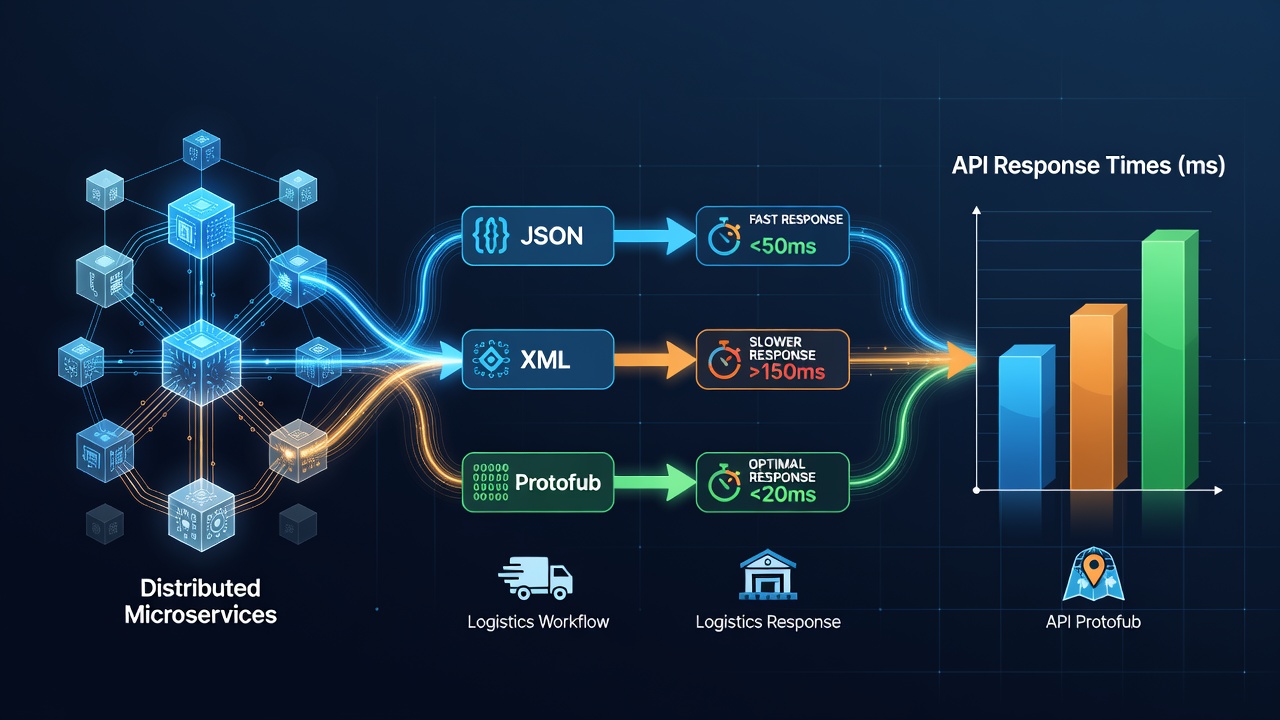
Benchmarks published in technical reports from Australian logistics research centers reveal concrete differences. A test suite simulating 10,000 concurrent tracking queries recorded median API response times of 85 milliseconds with JSON, 42 milliseconds with Protocol Buffers, and 38 milliseconds with Avro when all other variables stayed constant. The gap widened under packet loss conditions typical of satellite-linked maritime shipments, where smaller payloads recovered faster after retransmissions.
Those measurements align with findings from the U.S. Department of Transportation's connected vehicle program, which examined similar serialization patterns in freight data exchanges. Latency reductions translated into faster route recalculations and earlier alerts for temperature deviations in perishable cargo. Microservices handling authentication and logging introduced additional hops, yet the serialization layer remained the dominant variable when network latency stayed below 20 milliseconds.
Integration Patterns Across Global Supply Chains
Many operators combine multiple formats within the same architecture, routing high-frequency location pings through binary protocols while reserving JSON for administrative dashboards that require direct inspection. This hybrid approach appears in deployments documented by European Union transport innovation projects, where edge nodes near ports serialize data in Protocol Buffers before forwarding aggregated summaries in JSON to central analytics clusters. Such layering reduces overall system load without sacrificing compatibility for partner systems that expect standard web formats.
September 2026 brought new interoperability guidelines from the International Air Transport Association that encouraged logistics platforms to publish schema registries alongside their APIs. Early adopters reported smoother cross-border data flows because receiving services could validate incoming messages against shared definitions, cutting validation errors that previously triggered retries and inflated response times.
Operational Considerations in Practice
Teams responsible for maintaining these systems track serialization overhead through distributed tracing tools that tag each hop with timing data. Patterns emerge when one service switches formats while downstream consumers remain unchanged, sometimes creating mismatches that require adapter layers. Experts at research institutions in Singapore have documented cases where introducing a lightweight transcoding microservice offset the gains from a faster binary format until caching strategies were added.
Security layers such as encryption and signing interact with serialization choices because larger payloads take longer to process through cryptographic routines. Data from UK-based supply chain analytics firms indicates that combining Protocol Buffers with hardware-accelerated TLS reduced end-to-end times more effectively than applying the same acceleration to JSON traffic.
Conclusion
Serialization format selection shapes measurable performance characteristics in logistics microservice environments. Binary options consistently deliver smaller messages and quicker parsing, which compounds across distributed hops when tracking millions of shipments. Continued measurement and selective adoption of schema-aware formats help operators balance compatibility needs with response time targets in evolving supply chain networks.